Why an Equity in Grief Festival?
Updated: Aug 31

The Equity in Grief Festival was first conceived a year ago. At that time the team were grieving individually for the passing of close family members and friends and also experiencing collective grief because of the passing of two of colleagues. Vicarious grief was also a significant feature because the team was supporting others navigating their own grief journeys and involved in bereavement research. The research findings showed just how stark the inequity in grief is, so we set out to create an event to bring together voices from across communities, healthcare, academia and the arts. The aim was to understand, honour and make space for grief in all its forms whether visible or less visible and to do so with care, compassion and ensuring inclusion.
Grief manifest differently across communities so equity in grief means recognising that social conditions such as racism, poverty, ableism, colonialism, gender inequality, migration, violence, and social exclusion shapes not only how people die/ transition/ pass but who gets to be publicly mourned, named, and supported. Even the words and rituals used are heavily influenced by cultural, social, and personal attitudes and that also affects how individuals express, process, and experience grief. In some communities death is a final stage of life and for others, it is a time of transitioning or passing on to a new form of existence or even a continuation of life in a new realm.
We know from research and the findings from the UK Commission on Bereavement that structural inequalities have shaped which lives are lost, whose loss is recognised, and who can access culturally competent grief support. The evidence shows many service providers reporting inequities in access to bereavement support; that the lack of understanding of rituals and cultural nuances negatively impacts how communities are allowed to grieve; that bereaved children often feel unsupported in schools and that workplace policies are woefully inadequate because they are based on a one size fits all Eurocentric model of grief.
It is obvious that attention needs to be paid to identifying, assessing and addressing unmet needs so the festival was conceived as part of a bigger commitment to turn learning into change. The festival has been a step towards building that movement for that change as it was a space for everyone’s grief to be seen, for their pain to believed, their stories honoured and empathy expressed openly and freely.
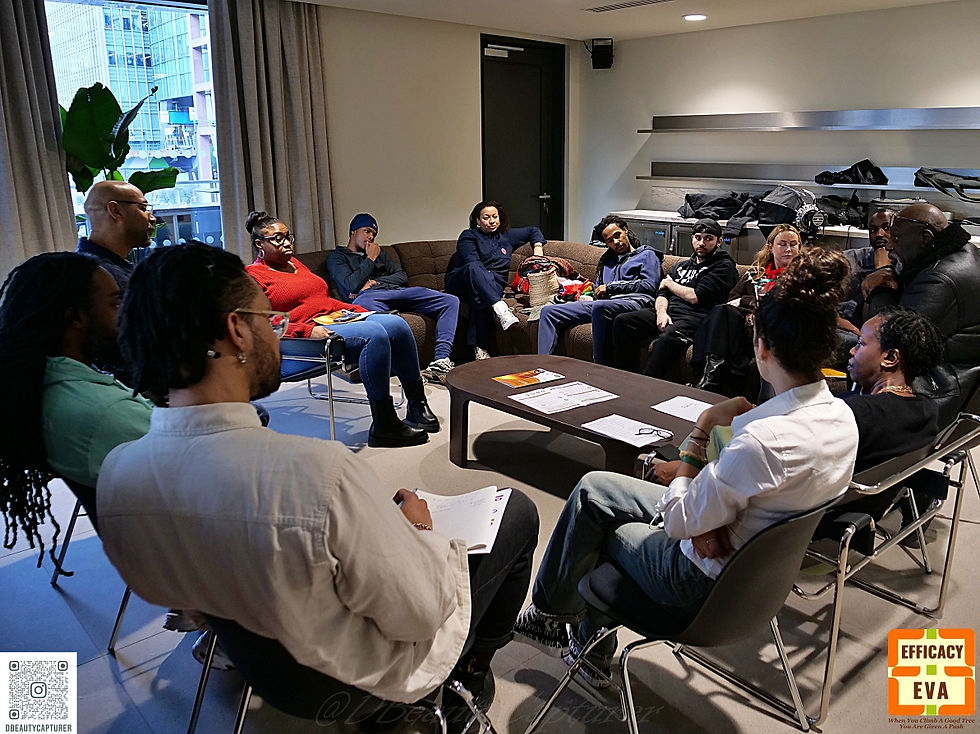
This is the start of a journey for the Black community as it provided the opportunity to talk, share and embrace grief and to delve deeper to find out which forms of grief are most often overlooked, dismissed, or stigmatised in society and why. There were a range of group conversations including:
How does historical trauma, structural violence, and ongoing inequality compounds individual and collective grief;
How to start exploring your mortality
Young people’s experiences of grief
Living with life limiting health conditions
Navigating babyloss and childlessness
In addition, there were a range of creative activities on Memorialisation, book and information stalls, art installations by the renown artist and sculptor Carl Gabriel
Some of the key take aways from the festival are :
The need for considerate and compassionate spaces where conversations on grief can be had and where collective community support and healing can happen.
The requirement for every school and employer to have a bereavement policy, with training and clear signposting—not as “good practice”, but as a minimum expectation.
Funding of culturally competent bereavement support shaped by experiences (including therapy in community languages) with access no longer being determined by geographic location, income, or race.
Back community-led memorialisation with microgrants to support art installations, memorial benches, tree planting, and remembrance events because public memory is part of public health.
Simplifying what people must do before and after someone has passed (admin, housing and financial security).
Recognising and treating grief equity as an inequality issue that requires resourcing, evaluating and that systems are held accountable for who is supported and who is left behind.
Essentially, the Equity in Grief Festival was not about fixing grief or moving past it. It was about listening; about connecting; and about bringing people together so that they feel less alone. It was about understanding that grief is not a problem to solve but a human response to love, loss, and injustice and that though it can be complicated, coming together in community can provide some comfort and healing.
People from very diverse backgrounds and communities attended either because of professional or career reasons, some were just curious, others are advocates and came along in solidarity; some came because they needed a space to feel a sense of belonging, to listen or be heard; and others came to accompany a friend or family member. Whatever drew them to attend there was space for everyone, and they didn’t need to intellectualise their experience of grief - their presence in the space was enough. They came with their vulnerability and an open mind and didn’t need to perform bravery, strength, or courage nor did they have to explain their pain even though they may have chosen to. What mattered was that they came as they were, stayed as long as they wanted and left feeling inspired.
Equity in Grief means acknowledging that every grief deserves dignity.
We are planning our next festival in September 2026 so please get involved and support this important initiative. Contact us via email at yr@efficacyeva.com

Comments